AI: The Tool Got Smarter. The Rules for Getting It Right Didn't Change

Plenty of lists are circulating right now describing how AI initiatives quietly go wrong: leadership announcing the technology instead of a result, pilots that drag on indefinitely without a real verdict, IT driving the whole thing solo, success measured by whichever demo felt most impressive rather than any real yardstick. All fair critiques. All real patterns.
But strip the word AI out of that list, and something becomes obvious: it's just a description of how technology decisions go wrong in general. Any technology decision.
Swap in “AMS.” Swap in “CRM.” Swap in whatever system your operations team has been quietly frustrated with for years. The underlying failures look the same:
- The purchase comes before the problem. Announcing “we're adopting AI” is a headline, not an outcome — no different from announcing a new platform without first agreeing on what it's actually supposed to fix.
- One department drives the decision alone. When finance, operations, compliance, membership, and the people who'll use the tool daily aren't in the room, they're also the first to notice when it doesn't fit — and the first to work around it quietly rather than say something.
- There's no way to know if it worked. No baseline, no defined finish line — so success ends up being whichever story sounded most convincing.
- Oversight shows up after the fact. Bringing in risk and compliance once something's already live means fixing what should have been designed correctly from the start.
- Nobody has asked what the fallback is. Weighing what inaction costs — and what a wrong bet costs — is a start-of-process question, not something to figure out afterward.
None of this is specific to AI. It's what happens any time an organization treats a technology decision as a purchase rather than an organizational choice — skipping the groundwork, skipping the people who'll actually be affected, and expecting the tool itself to supply the strategy.
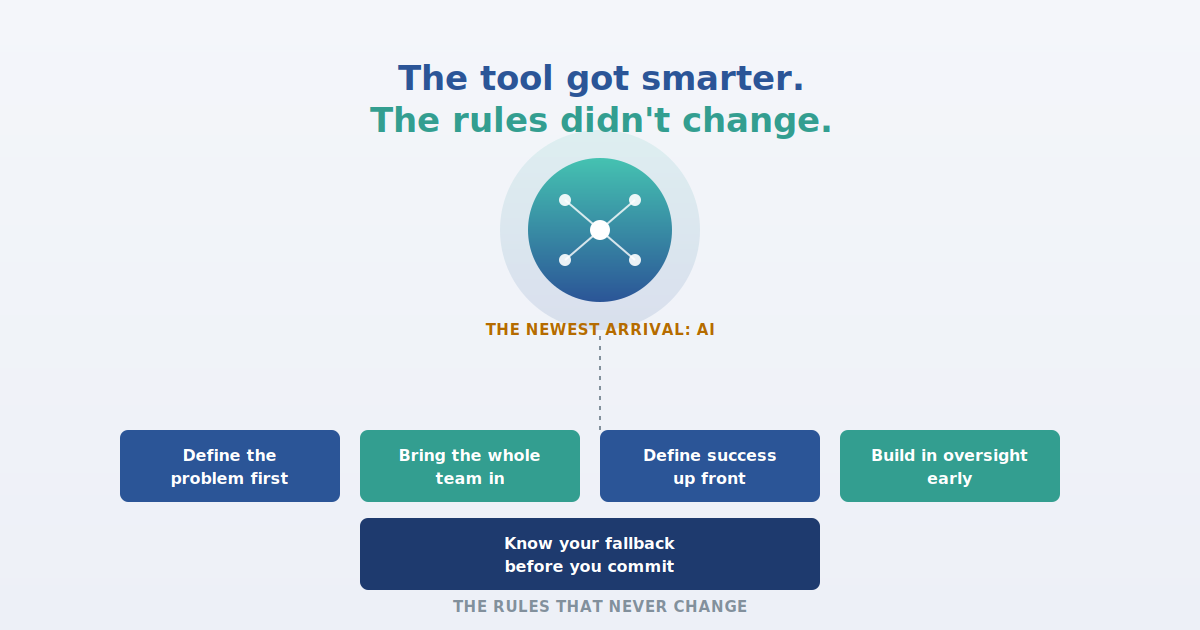
AI raises the stakes mainly because things move faster and the downside is harder to spot until it's already a problem — a clunky new tool generates a help-desk ticket, while a flawed automated decision can spread quietly into something with real compliance or reputational consequences. But the discipline that prevents it is exactly the discipline that prevents a failed platform rollout: define the actual problem before shopping for a solution, involve the people closest to the work, agree on what success looks like in advance, check the inputs before you scale, and have an answer ready for what happens if it doesn't pan out.
The technology is new. The way these projects fail isn't. Give AI adoption the same rigor you'd give any other major, multi-year technology commitment, and most of these problems never get a foothold.
Need help with this? We specialize in helping associations with their AI future. Contact Cimatri to talk about it.

Related Posts