Your Data Doesn’t Have to Be Perfect to Start

Written by Sara Spalt
One of the most consistent things I hear from association leaders when the topic of AI comes up: “We need to get our data in order first.”
The instinct makes sense. If you’re going to rely on AI to surface insights about your members, you want to trust what it’s working from. But “getting data in order” has a way of becoming a large, multi-year project that quietly stalls — and by the time an organization is still debating what “clean” means, the window for getting started has passed.
The organizations making real progress with AI have taken a different approach.
The Actual Problem
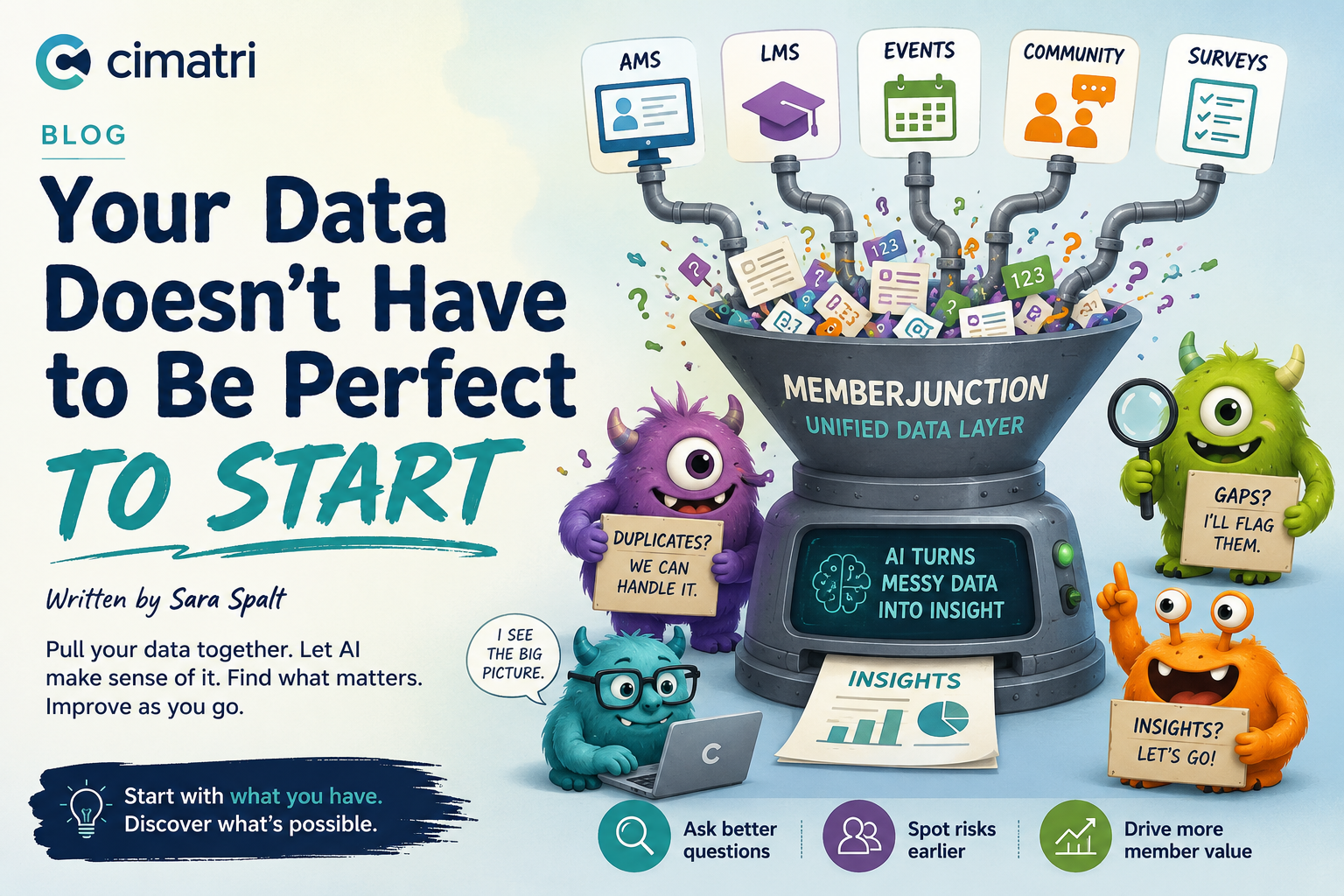
Most associations have more data than they realize, spread across more systems than anyone wants to manage. There’s the AMS, the LMS, an events platform, a community system, maybe a survey tool. Each one holds a piece of the member picture. None of them talk to each other particularly well.
The result is that even basic questions — Which members are quietly disengaging? Who’s at renewal risk? Which programs are actually driving value? — require pulling data from multiple places, reconciling it by hand, and hoping the logic in last year’s spreadsheet still holds.
The root of the problem is fragmentation. Data living in separate systems, in different formats, with no shared structure. That’s what makes member data feel unusable — not the fact that some records are messy.
Why Waiting for Perfect Sets You Back
Classical data governance frameworks start with a familiar sequence: define your data model, set your standards, clean your records, establish ownership, and then — once all of that is done — begin using your data strategically. The logic is sound on paper. But in practice, this approach is rarely fully implemented and even more rarely maintained over time.
Data governance projects are slow, expensive, and easy to deprioritize when other demands surface. They require a level of sustained organizational discipline that’s hard to hold over the years it takes to do the work right. And by the time an association feels ready to act, the tools and the landscape have often shifted enough that the exercise needs to start again.
What gets lost in the wait is real. Member needs are shifting. Renewal risks are developing. Programs that worked a few years ago are quietly becoming less relevant. All of that is visible in your data — if you can get to it.
A Different Premise
MemberJunction (MJ) is built around a different starting point: pull your data together into a unified physical layer first, and let AI do the work of making sense of it.
Rather than requiring clean, standardized records as a precondition, MJ connects to your existing systems through APIs — your AMS, your LMS, your events platform, wherever your data currently lives — and brings it into one place. From there, AI can work across divergent, inconsistent data in ways that manual processes simply can’t.
The core insight is that AI handles messy data well, as long as it can see all of it together. Duplicate records, inconsistent formats, gaps in history — these are real problems, but they’re problems AI can flag, work around, and surface for resolution as you go. That’s a fundamentally different model than asking staff to solve everything before any analysis can happen.
What Opens Up When You Start
When member data from across your systems lands in one place — even imperfectly — you can ask questions you couldn’t ask before. You can see engagement patterns across programs rather than within each one in isolation. You can identify members who are quietly pulling back before they make a renewal decision. You can see which content and programming is actually being used.
And as you work with the data, the things worth fixing become visible. The data cleanup that matters — the kind that sticks — tends to happen this way, surfaced by actual use rather than prescribed in advance by a governance committee.
Starting From Here
The associations building real AI capability right now aren’t the ones waiting for conditions to be ideal. They’re the ones that pulled their data together with what they had, started asking questions, and let the work of improvement follow from there.
If you’ve been deferring an AI strategy because the data doesn’t feel ready, that reasoning is worth revisiting. The platform exists to work with what you have. And starting is how you find out what actually needs to change.

Related Posts

Warning: Undefined variable $post in /nas/content/live/cimatri/wp-content/plugins/oxygen/component-framework/components/classes/code-block.class.php(115) : eval()'d code on line 9