The Questions Your AMS Implementation Didn't Answer

The association sector knows how to celebrate a go-live. After months of planning, configuration, data migration, and stakeholder alignment, getting a new system live is a real achievement — and it deserves to be recognized as one.
What tends to get less attention is the work that starts the day after.
What Implementations Are Built to Do
An AMS implementation has a clear mandate: get the system configured, get the data migrated, get staff trained well enough to operate, and go live on schedule. That is what the project plan is designed to accomplish, and when it works well, that is what it delivers.
What it is not designed to answer are the operational questions that only surface once real work starts running through the system. Edge cases the configuration did not anticipate. Integrations that tested cleanly but were not stressed against actual renewal volumes. Vendor response times that looked reasonable in the contract but feel very different when a batch process is stuck and staff are waiting.
These are not failures of the implementation. They are simply questions that an implementation is not built to ask.
Where the Questions Accumulate
In the months following go-live, something predictable happens: the project team disbands, the vendor relationship shifts from implementation mode to support mode, and the operational questions land squarely with staff who are still learning the system.
Most associations manage through this period without a structured plan. Issues get handled as they arise. Informal workarounds develop. Assumptions accumulate — about data ownership, about who has authority over what, about whether the numbers in the system match the numbers in the ledger.
When I work with organizations during this window, what we find usually is not catastrophic. It is the buildup of questions that never got formally answered: Which platform is the authoritative source for a member's communication preferences? What happens when a transaction does not complete? Who at the vendor escalates when a ticket has been open for three weeks? Does the association actually own the data in its own AMS?
What Post-Go-Live Actually Requires
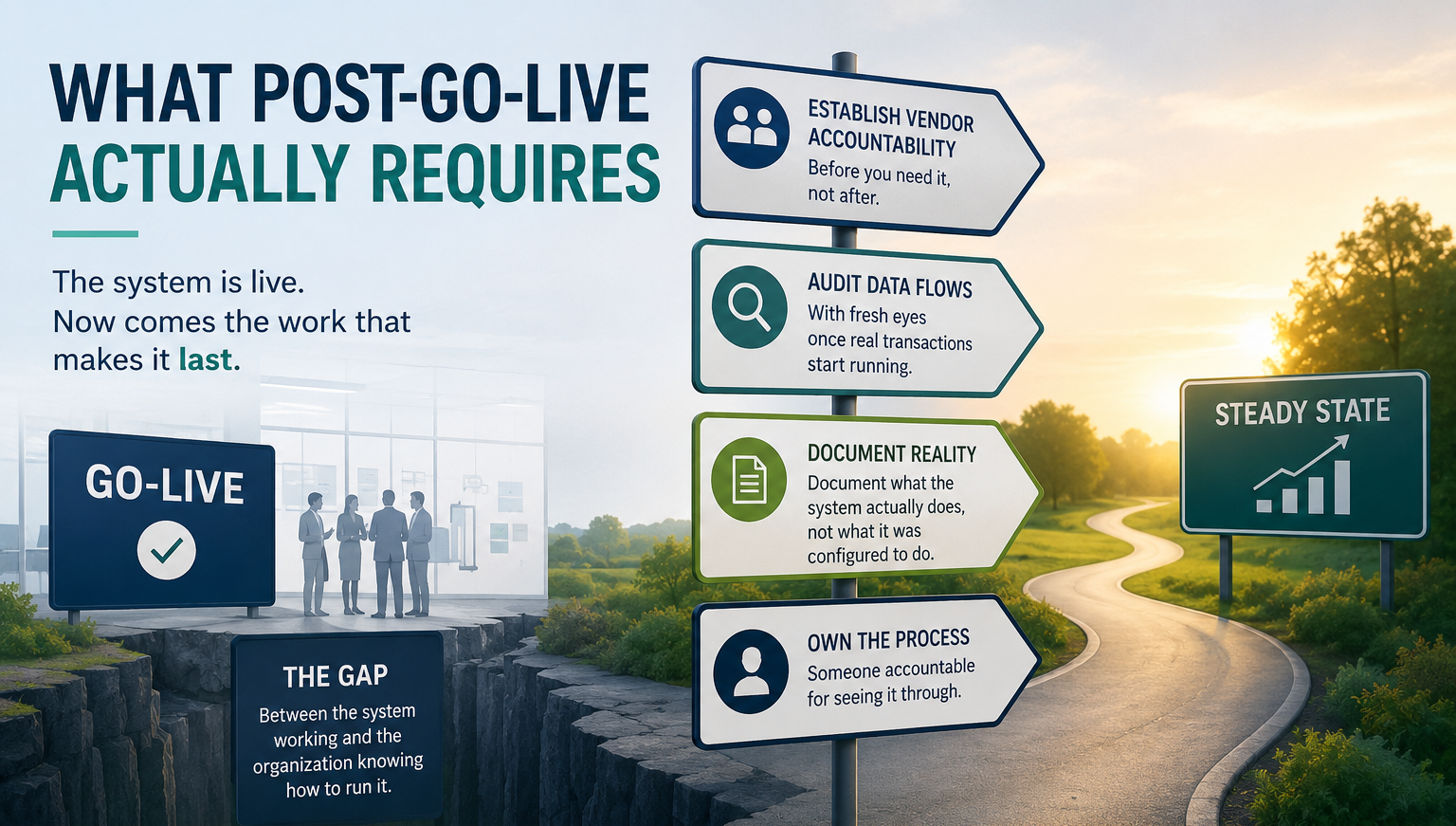
The gap between the system working and the organization knowing how to run it is real, and usually wider than anyone expects. Closing it requires treating post-go-live as its own phase — with its own goals, its own timeline, and someone accountable for seeing it through.
That means establishing vendor accountability structures before they are needed, not after. Auditing data flows with fresh eyes once real transactions start running through them. Documenting what the system actually does rather than what it was configured to do.
None of this generates the energy of an implementation kickoff. But it is the work that determines whether the investment in a new system pays off over time — or quietly erodes under the weight of unresolved questions that no one officially owns.
A Phase That Rarely Gets Planned For
Our field spends a lot of time on AMS selection and implementation. Post-implementation stabilization rarely makes it onto the conference agenda or into the project budget.
If you are in the 12 to 18 months after a major technology transition — or approaching the end of an implementation and starting to think about what steady state actually means — it is worth building stabilization into your planning before you need it. The operational questions will surface either way. The difference is whether you are ready for them.
Cimatri works with associations at every stage of the technology lifecycle, including post-implementation. Contact us to talk through what a structured stabilization approach might look like for your organization.

Related Posts