Your Engagement Score Isn't a Crystal Ball

Written By Sara Spalt
November 19, 2026 | Application Selection & Implementation, Data Analytics and Reporting, Data Architecture & Governance, Tech Trends, Uncategorized,
Written by Sara Spalt
When associations start talking about engagement scoring, the questions usually sound like this: Which members are going to renew? Who is likely to lapse? Which prospects will join?
Those are good questions. They are also prediction questions. And most engagement scoring, including the kind I'd recommend most associations start with, isn't built to answer them directly.
That distinction sounds technical, but getting it right early saves a lot of frustration later. And as AI makes both approaches easier to build, it matters more, not less.
What an Engagement Score Actually Is
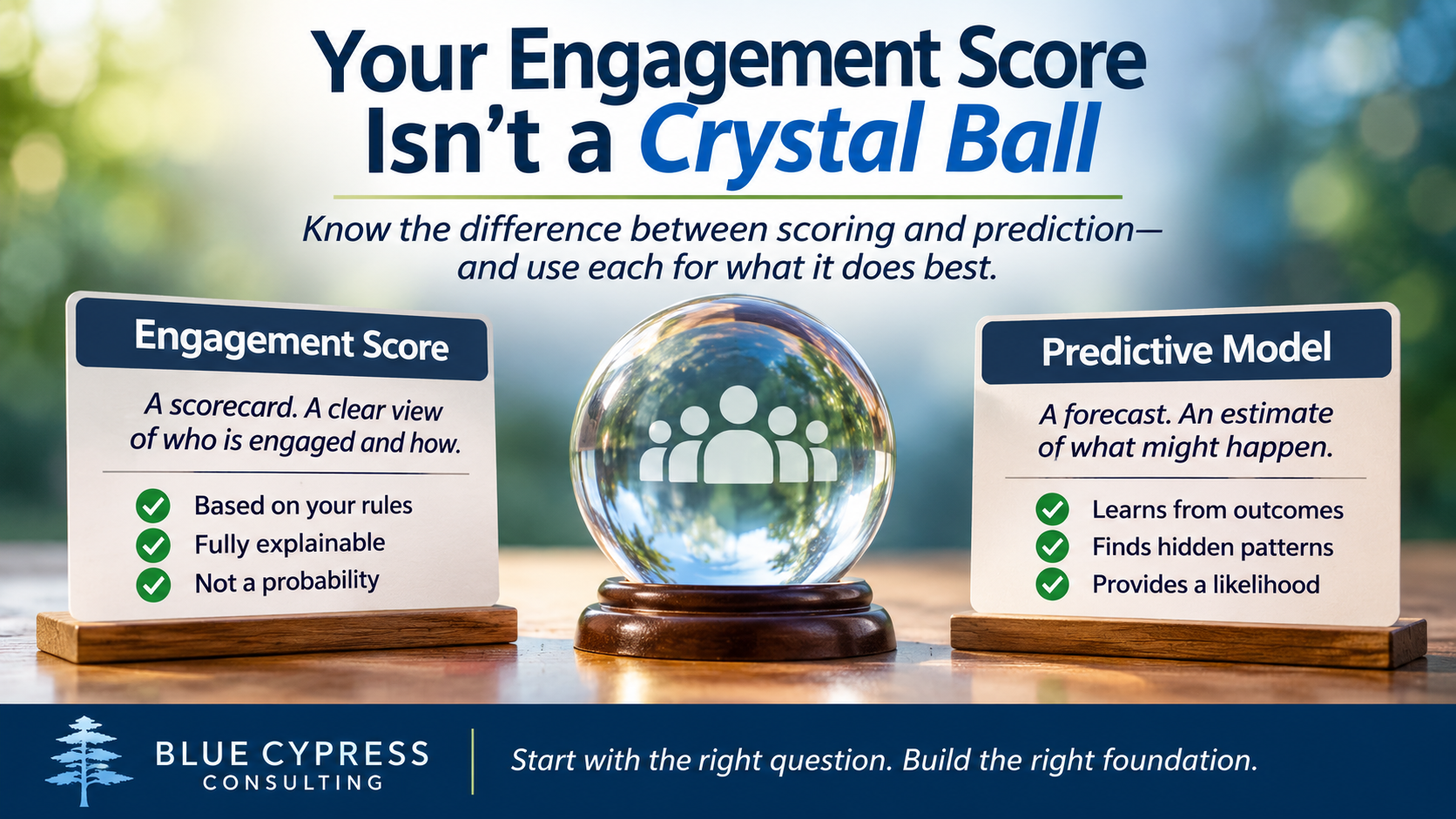
An engagement score is a scorecard. Your organization decides which behaviors matter, such as attending events, serving on committees, presenting, publishing, or simply staying a member year after year. You decide how much each one counts. The system adds it up and gives every member a score.
That has real advantages. Every score can be explained. A staff member can look at a member's score and see exactly why it is what it is: three events, one committee role, twelve years of membership. When priorities shift, you change the weights. Nothing about it is a black box.
What a scorecard does not do is learn. It reflects the rules you gave it. It describes what members have done, through the lens of what your organization values. It does not calculate the odds of what they will do next.
What a Predictive Model Does Differently
A predictive model starts from outcomes rather than rules. It looks at members who renewed and members who didn't, finds the patterns that separated them, and uses those patterns to estimate the likelihood for members who haven't decided yet.
That requires a few things a scorecard doesn't: enough history to learn from, clearly recorded outcomes, and a way to test the model against data it hasn't seen before. When those pieces are in place, a predictive model can surface patterns no one would have thought to write into a rubric.
Neither approach is better in the abstract. They answer different questions.
Why the Difference Matters
The risk is not choosing the wrong tool. It's using one tool while describing it as the other.
If leadership hears "engagement score" and assumes it predicts renewal, they will judge it as a forecast. The first time a highly scored member lapses, trust in the whole effort takes a hit, even though the score was never designed to make that call. I've seen staff skepticism from an earlier analytics project follow a new initiative for years.
Language makes this worse than it needs to be. A band called "High Lapse Risk" sounds like a probability, even when it really means "this member shows several warning signs we defined." A model described as "trained" sounds like machine learning, even when it means "tuned by staff." Small word choices shape what people expect.
The fix is simple: say plainly what the score does. It shows who is engaged and how. It flags warning signs you care about. It is not a calculated probability.
How Scoring Sets Up Prediction
None of this means engagement scoring is a lesser step. In most associations, it is the right first one.
Building a scorecard forces the work prediction depends on: connecting data across systems, agreeing on which behaviors matter, and finding out which data is actually complete. The signals you define become the inputs a predictive model will use later. And every time scores are recalculated, you build the history a model needs to learn from.
There is also a simple bridge between the two. Once members are scored, compare last year's renewal rates across score levels. If your most engaged members renewed at much higher rates than your least engaged, the scorecard is capturing something real. If not, your weights need another look. It isn't prediction, but it is evidence, and it tells you which behaviors are worth carrying forward.
Where AI Fits
AI shows up on both sides of this line, which is part of why the two get confused.
On the scoring side, AI makes the work faster and easier to understand. You can describe what engagement means to your organization in plain language and get a draft model to react to. It can translate a member's score into a sentence a staff member can actually use, like "two committee roles and three conferences, but no activity this year." What it doesn't do is turn a scorecard into a forecast. The score still reflects the rules you chose.
On the prediction side, machine learning is the engine. It finds patterns in past outcomes that no one wrote down, which is exactly what makes it powerful and exactly why it needs good history to learn from.
The practical barrier for most associations isn't the AI. It's getting member data out of separate systems and into one place. In our work with MemberJunction, a data platform built for associations, that unified foundation is what makes the rest move quickly. Once AMS, event, email, and other data sit together, a team can build an engagement model, score the full membership, and adjust it the same day. The same data can then feed predictive models when the organization is ready.
Just as important, that data doesn't need to be complete or clean before you begin. Amith Nagarajan, chairman of Blue Cypress, has made this point for years. On Sidecar's podcast episode devoted to data, he called cleanup a “false obstacle” and warned that “if you try to clean up your data, you will fail.” AI can work with flawed records and fill in gaps that would take people years to fix by hand. Building a scorecard is also one of the fastest ways to learn which gaps actually matter.
Questions to Ask Before You Start
- What decision will this score inform? Choosing who to invite to lead and choosing who to call before renewal are different jobs.
- Do we need to describe engagement, or forecast an outcome? Be honest about which one leadership is expecting.
- Do we have recorded outcomes to learn from? If renewal history is incomplete, start with a scorecard and build the history as you go.
- How will we explain it to staff? If the people using the score can't explain it, they won't act on it.
Start With What You Can Explain
Engagement scoring gives associations something they rarely have: a shared, explainable view of who is involved and how, updated as members act. Prediction can come next, and it will be better for the groundwork. The key is being clear about which question you are answering today.
Blue Cypress Consulting helps associations design engagement models that staff trust and use, and plan the path from scoring to prediction. Contact us to talk through what that could look like for your organization.
Written by Sara Spalt

Related Posts

Warning: Undefined variable $post in /nas/content/live/cimatri/wp-content/plugins/oxygen/component-framework/components/classes/code-block.class.php(115) : eval()'d code on line 9