Why Your Association's AI Initiative Might Fail (And It Has Nothing to Do with Technology)
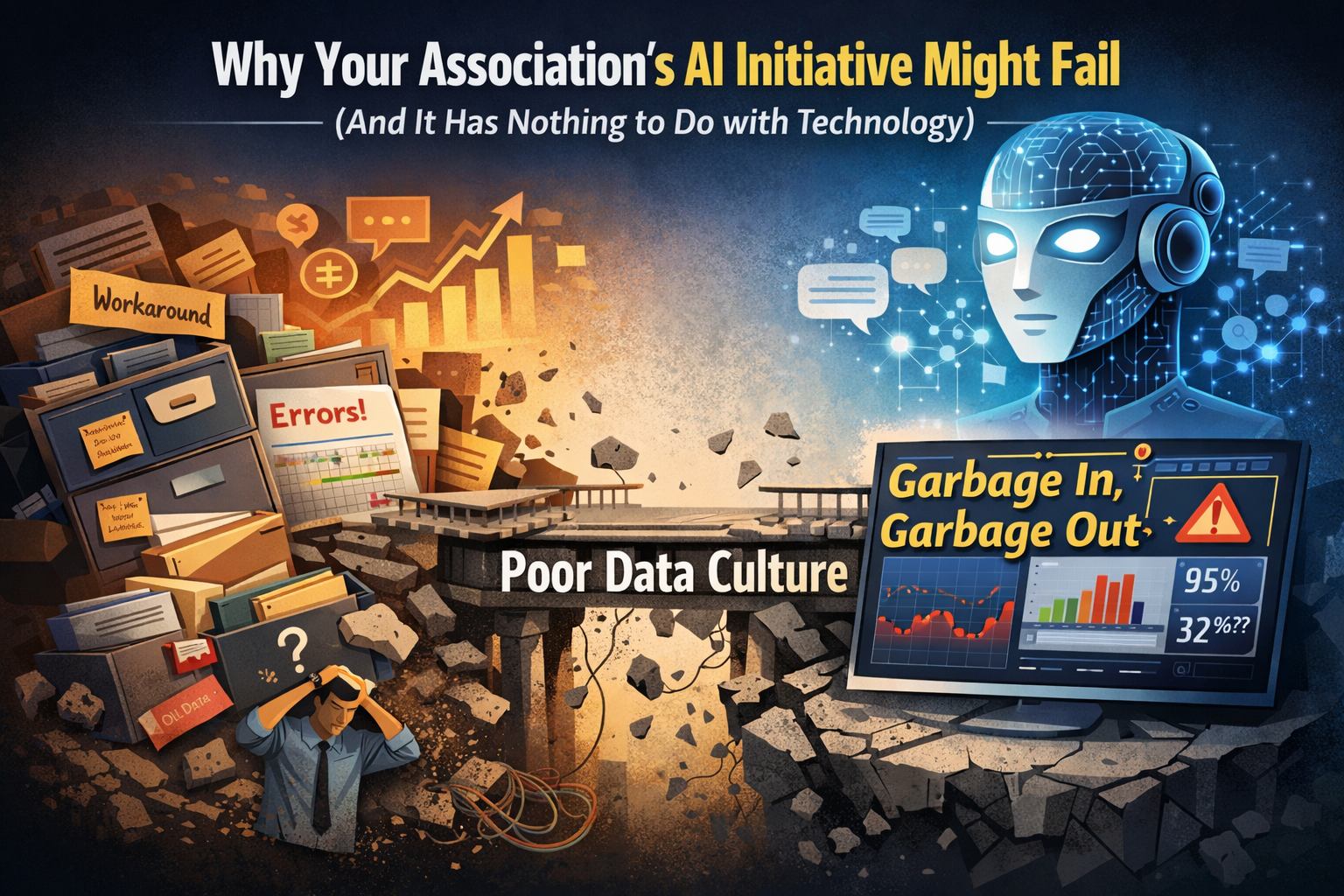

Every association wants to talk about AI. Predictive member engagement. Automated content personalization. Intelligent search. ChatGPT-powered member service. The promise is compelling: do more with less, understand members better, stay competitive.
But here's what nobody wants to hear: your AI initiative might fail. Not because the technology isn't ready. Not because you picked the wrong vendor. But because your data governance culture isn't there yet.
The Culture Problem Nobody's Talking About
Data governance sounds bureaucratic. It conjures images of policies nobody reads and committees that meet quarterly to discuss data dictionaries. But data governance culture is something entirely different—it's how your organization actually treats data every single day.
And in most associations, that culture looks something like this:
The membership team maintains their own spreadsheet of "real" member data because they don't trust what's in the AMS. They've been burned too many times by records that don't match reality.
The education department built their own LMS integration because IT's timeline was too long, and now nobody's quite sure which system owns the truth about CE credits.
The events team manually reconciles attendee lists across three systems after every conference because the data "just doesn't sync right."
Leadership makes strategic decisions based on whatever numbers look best in the moment, because different reports from different systems tell different stories.
This isn't negligence. This is survival. Staff have learned to work around data problems because fixing them felt impossible.
But here's the brutal truth: you cannot build AI on top of a culture of workarounds.
Why AI Amplifies Your Data Culture Problems
AI doesn't fix data problems—it inherits them at scale.
When you train a predictive model on member engagement using data where:
- Email opt-outs aren't consistently recorded across systems
- Event attendance is missing for anyone who registered by phone
- Member categories were changed mid-year without updating historical records
- Demographic data is self-reported in one system and administrator-entered in another
You don't get insights. You get expensive nonsense delivered with mathematical precision.
The AI will confidently tell you that members who registered by phone are less engaged (because you don't have their event attendance data). It will recommend targeting certain demographics (based on whichever system's definition of that demographic won the data quality lottery). It will predict renewal likelihood based on patterns that reflect your data collection gaps, not actual member behavior.
Garbage in, garbage out—but now the garbage comes with a confidence score and a dashboard.
The Three Cultural Indicators That Predict AI Readiness
Forget AI maturity assessments for a moment. Here are three questions that tell you more about your AI readiness than any technical evaluation:
1. Can your staff answer "What does this field mean?" consistently?
Not "Is it documented in the data dictionary?" but "If I ask three different people what 'Member Type' means, do I get three different answers?"
In associations with strong data governance culture, there's shared understanding of what data means. Staff know what "Active Member" includes and excludes. They understand why certain fields are required. They can explain what changed when they see an anomaly.
In associations without that culture, every department has their own interpretation. Membership defines "engagement" differently than education, which defines it differently than advocacy. Nobody's wrong—they're just solving for different things. But you can't train an AI on data where the fundamental terms mean different things to different people.
2. When data looks wrong, do people fix it or route around it?
Watch what happens when someone pulls a report and the numbers look off.
Strong data culture: "This doesn't look right—let me investigate the source and fix it, or flag it for IT if it's a system issue."
Weak data culture: "This report is useless, I'll just pull the data from [other system] instead."
Routing around bad data is faster. It's often the right call for urgent decisions. But when it's the default response, it means your organization has given up on data quality. And if humans can't trust the data enough to use it directly, why would you feed it to an AI?
3. Who owns member data quality?
The real answer, not the org chart answer.
If the answer is "IT" or "the database manager" or "whoever enters it," you have a problem. Because data quality is a daily choice made by dozens of people. Every time someone enters a record, updates an address, processes a registration, or runs an import, they're making data quality decisions.
In strong data cultures, everyone who touches data feels ownership of its quality. They understand that the data they enter affects colleagues downstream. They know why data standards matter. They have a path to report problems and see them fixed.
In weak data cultures, data quality is someone else's job. "I just enter what they tell me" or "That's what the import file had" or "It's not my job to clean this up."
You cannot automate your way out of cultural abdication of data responsibility.
What This Actually Means for Your AI Strategy
Here's what makes this particularly hard: your AI initiative probably has executive sponsorship, budget, and urgency. Your data governance culture has none of those things. Data governance sounds like overhead. AI sounds like innovation.
But you cannot skip the cultural work. And that cultural work takes time.
If you have weak data governance culture, you have three options:
Option 1: Build culture while building AI (Realistic timeline: 18-36 months)
Start with a narrow AI pilot that exposes data problems in a contained way. Use the pilot's failures as proof points for data governance investment. Build cross-functional data ownership into the project structure. Celebrate data quality improvements as wins. Gradually expand as culture shifts.
This is slow. It feels inefficient. But it builds something sustainable.
Option 2: Scope AI to work within cultural constraints (Realistic timeline: 6-12 months)
Choose AI applications that don't require cross-system data integration. Focus on single-source use cases where data ownership is clear. Accept that you're solving narrower problems than you wanted. Be honest about limitations.
This works, but it's not transformative. And it doesn't prepare you for more ambitious AI later.
Option 3: Ignore culture and proceed (Realistic timeline: 3-6 months to failure)
Buy the platform. Hire the consultants. Build the models. Watch them produce results nobody trusts. Spend months investigating why predictions are wrong. Realize it's data problems. Try to fix data problems without culture change. Watch data quality improvements fail to stick. Abandon the initiative. Conclude "AI doesn't work for associations."
This is remarkably common.
The AI-Common Data Platform Advantage
Here’s the good news: AI-enhanced common data platforms (AIDPs) or data warehouses are powerful tools for resolving data fragmentation. They force data definition conflicts to the surface, provide a natural home for data quality rules, create consistent schemas that machine learning models can rely on, and dramatically reduce the time spent on data preparation for AI projects.
But an AIDP will only solve your data problems if you use its implementation as the catalyst for culture change. The platform is the tool, not the solution. The solution is using an AIDP implementation to finally get departments to agree on what “member type” and “engagement” actually mean, establish clear data ownership, and build feedback loops where data quality issues get reported and fixed.
So if you’re considering an AIDP: do it. But approach it as a culture change initiative that happens to involve technology. When we help clients implement platforms like MemberJunction, we treat it as a culture initiative, not just a technical one. The technology will only amplify whatever culture you bring to it.
The Path Forward: Making Data Culture an Asset, Not an Afterthought
The good news: associations that invest in data governance culture don't just make AI possible—they make everything easier.
Start with visibility, not policy. Before you create data governance frameworks, help people see how data flows through your organization. Where does member information originate? Where does it get copied? Where do disconnects happen? You can't fix what you can't see.
Create feedback loops, not mandates. When someone enters bad data and it causes a problem downstream, make sure they learn about it. Not as blame, but as information. "Hey, when addresses are entered without ZIP codes, it breaks the event check-in system" is actionable. "Data quality is everyone's responsibility" is not.
Celebrate data stewardship, not just data innovation. The staff member who catches and fixes a data integrity issue before it cascades should be recognized just as much as the staff member who suggests a new AI application. Culture is what you reward.
Tie data quality to outcomes people care about. "We need clean data for AI" is abstract. "We can't reliably predict who's at risk of not renewing because our engagement data is inconsistent across systems, and that's costing us $X in preventable membership losses" is concrete.
Start small, but start. You don't need perfect data governance culture to begin. You need enough data governance culture for your next initiative. Build from there.
The Uncomfortable Truth
Your association needs AI. Member expectations are changing. Operational efficiency matters. Staying competitive requires leveraging your data assets.
But you need data governance culture just as much.
Because AI built on a weak data culture doesn't just fail to deliver value—it actively makes things worse. It enshrines workarounds into automation. It scales bad assumptions. It produces confident recommendations based on flawed understanding. And when it inevitably fails, it makes your organization more skeptical of data-driven decision making, not less.
The associations that will succeed with AI aren't the ones with the biggest AI budgets. They're the ones where staff trust their data, understand what it represents, and take responsibility for its quality. Where data governance isn't a policy framework—it's how work gets done.
Build that culture first. The AI will follow.
This post reflects Cimatri insights from years of technology consulting with associations, including many data governance assessments and AI readiness evaluations. If your association is navigating the intersection of data governance and AI strategy, particularly including AIDPs like MemberJunction, we should talk.

Related Posts