Vibe Coding: What Association Executives Need to Know

This post is intended to orient association executives to an emerging space. Technology capabilities and tool landscapes in AI-assisted development are evolving rapidly; leaders are encouraged to conduct ongoing learning and consult technical advisors as they develop organizational approaches.
There is a quiet revolution happening in how software gets built, and it is moving faster than most association leaders realize. It goes by an unlikely name: vibe coding. And while it may sound like something invented in a Silicon Valley co-working space by someone who owns too many succulents, the underlying concept is serious, consequential, and worth your attention.
Here is what you need to understand about it — and how to decide whether it belongs in your organization.
What Is Vibe Coding?
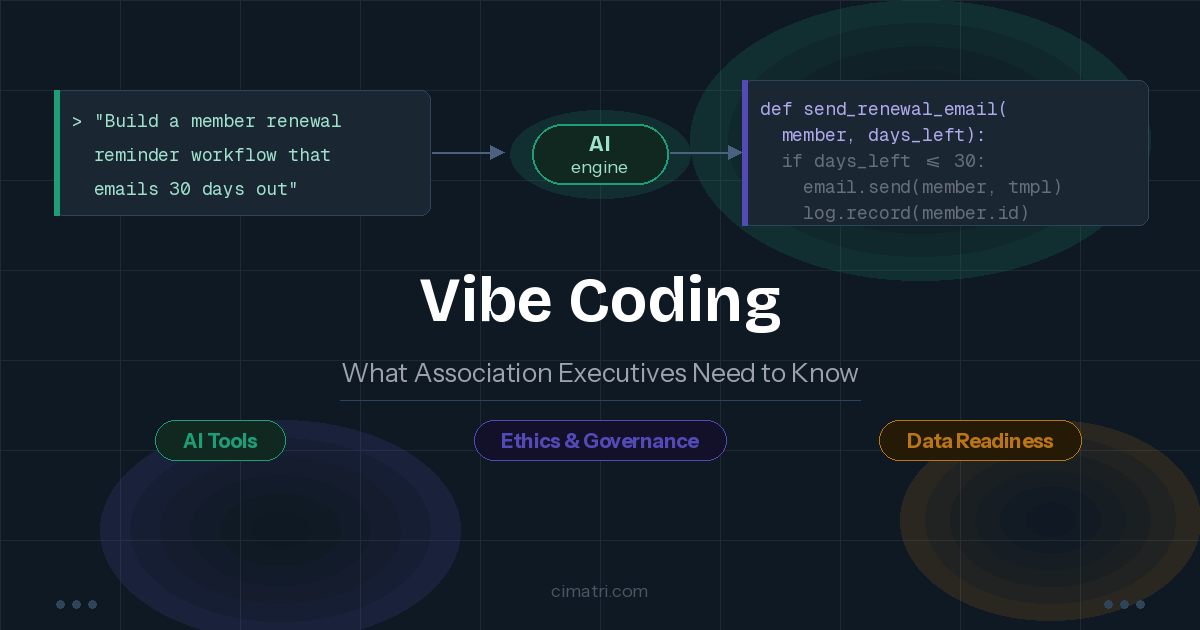
The term was coined in early 2025 by Andrej Karpathy — a co-founder of OpenAI and former Senior Director of AI at Tesla — who described a mode of software development in which a person describes what they want in plain language, and an AI coding assistant generates the actual code. The human's role shifts from writing syntax to directing intent — essentially "vibing" with the AI rather than commanding a compiler.
In practice, vibe coding looks something like this: you open an AI tool, type "build me a member event registration form that connects to our database and sends a confirmation email," and the system produces working code. You review it, refine your prompts, test the output, and iterate. At no point do you necessarily write a single line of Python, JavaScript, or SQL yourself.
Vibe coding is related to — but meaningfully different from — earlier low-code or no-code tools. Those platforms traditionally abstracted complexity through pre-built components and visual drag-and-drop interfaces. Vibe coding uses generative AI to produce original code from natural language, which means it is far more flexible, far more powerful, and far more unpredictable. That said, the line between these categories is blurring: many modern low-code platforms like Retool and Appsmith have begun integrating AI code generation into their workflows, and some dedicated vibe coding tools offer visual interfaces of their own. The landscape is converging, but the core idea — directing software development through natural language intent rather than manual construction — remains the distinguishing feature of the vibe coding approach. It is also worth noting an emerging distinction between vibe coding and what is increasingly called agentic coding — a more advanced mode in which AI does not merely generate code from a prompt but autonomously scaffolds entire applications, operates tools, and runs multi-step workflows end to end with minimal human direction. The tools and platforms described in this post span both categories, and the line between them is likely to blur further as the technology matures.
Is It Appropriate for the Association Environment?
The short answer is: yes, in the right contexts, with the right guardrails. It helps to reframe the question slightly. Every association already delivers digital experiences to its members — portals, registration systems, credentialing workflows, resource libraries. Whether or not you think of your organization as a software company, you are already in the business of building and maintaining software-driven member experiences. Vibe coding does not introduce that reality; it changes what is possible within it.
Associations are not software companies. Most operate with lean staff, stretched budgets, and a genuine need to do more with less. Historically, that has meant choosing between expensive custom development, rigid off-the-shelf platforms, or simply going without. Vibe coding introduces a third path: mission-aligned staff who can build tools, automate workflows, and prototype new member services without waiting months for an IT vendor or spending six figures on a developer. Imagine your membership coordinator building a working prototype of that onboarding improvement by Friday, or your events team creating a custom registration workflow over a long weekend — these are not hypothetical scenarios. They are happening now at organizations that have embraced this approach thoughtfully.
The use cases are real and growing. Member-facing tools such as custom calculators, resource finders, or event registration workflows are well within reach. Internal automation — pulling data from your AMS, generating reports, connecting systems that don't talk to each other — is an area where vibe coding can deliver immediate ROI. Board portals, chapter communication tools, and lightweight dashboards are all reasonable candidates.
That said, vibe coding is not appropriate for every problem. High-stakes systems — payment processing, personally identifiable information, credentialing records, financial reporting — may require professional developers who can reason carefully about security, reliability, and regulatory compliance. Vibe coding is a powerful supplement to professional development capacity, not a replacement for it. It is worth noting, however, that this approach is not limited to small teams or resource-constrained environments. Enterprise development teams across industries are already using AI-assisted coding to accelerate production-grade work — and the tools are rapidly scaling up in capability and becoming more broadly accessible. Vibe coding scales up, not just down.
What Skills Are Needed?
Here is where many organizations stumble. Vibe coding lowers the floor of software development dramatically, but it does not eliminate the need for judgment, context, and accountability.
The people best suited to vibe coding in an association context tend to combine several capabilities. They should be analytically comfortable — able to read code outputs at a high level, even without writing code themselves, and recognize when something looks wrong. They need strong problem-definition skills: the quality of AI output is directly proportional to the clarity of the prompt. Vague direction produces vague results. They should also understand data sufficiently to know what they're asking the system to touch, move, or transform.
Perhaps most importantly, effective vibe coders cultivate what might be called productive skepticism. AI models confidently produce incorrect code. They sometime miss edge cases. They make security errors. The vibe coder who accepts every output at face value is setting their organization up for failure. The one who tests rigorously, asks the AI to explain its reasoning, and escalates when something feels off is the one who delivers value.
It is worth distinguishing between two levels of skill here. To experiment and prototype — to explore what vibe coding can do and produce a useful proof of concept — the bar is genuinely low. Curiosity, a willingness to feel temporarily uncertain, and the ability to describe a problem clearly are sufficient to get started. Many association staff discover they can produce a working first result within hours, not weeks.
The higher bar applies when it is time to deploy and maintain what gets built. That is where analytical comfort, productive skepticism, data awareness, and rigorous testing become essential. Organizations should not let the deployment-level skill requirements discourage experimentation-level exploration. The two stages require different postures, and conflating them risks raising the perceived barrier to entry higher than it needs to be. Formal software engineering experience is genuinely not required at either level. But curiosity, careful thinking, and a willingness to verify are non-negotiable — and the good news is that those qualities are already abundant in most association teams.
What Tools Are Needed?
The AI-assisted development landscape is evolving rapidly, and any snapshot of the tooling market will have a short shelf life. That said, several categories of tools have emerged, and understanding the landscape at a category level is more useful than betting on any single product.
AI-native code editors represent the most full-featured approach. Cursor was an early leader in this category and remains popular, but it now competes with tools like Windsurf and GitHub Copilot's increasingly capable agent mode within VS Code. These editors integrate large language model assistance directly into the coding environment and handle the back-and-forth of iterative development particularly well. For organizations already operating in Microsoft's developer ecosystem, GitHub Copilot is a natural starting point.
A newer category of browser-based vibe coding platforms — including Replit Agent, Bolt, and Lovable — has gained significant traction by making it possible to describe, build, and deploy simple applications entirely through a conversational interface, often without installing any development tools at all. These platforms are particularly accessible for staff who are just beginning to explore the space.
Anthropic's Claude ecosystem deserves separate mention. Claude Code is an emerging bridge between general-purpose assistants and full IDE-based editors, turning conversational descriptions into working applications through an iterative dialogue and handling complex multi-step processes without requiring a traditional development environment. Claude Cowork extends this into a collaborative, organization-level platform where teams can build and deploy applications and agents with built-in permission controls — starting from a security-first posture that grants access incrementally rather than requiring users to restrict it after the fact. Anthropic has also released Claude Dispatch, which allows remote interaction with Claude Cowork from any device, including through messaging platforms, with the same permission controls. These tools have gained significant traction in the association-adjacent space and are worth evaluating alongside the editors listed above. General-purpose AI assistants like ChatGPT and Gemini can also be used for vibe coding, especially for prototyping, generating utility scripts, or working through logic problems before committing to a more structured tool.
The broader agent ecosystem is also developing rapidly. Platforms like ClawHub serve as open skill registries — marketplaces where developers publish and share agent capabilities that can be installed and composed into larger workflows, much like a package manager for AI agents. These registries are accelerating the pace at which non-technical staff can assemble sophisticated automated workflows by combining pre-built agent skills rather than coding from scratch. The agent landscape also includes open-source tools like OpenClaw, which give AI models the ability to take actions directly on a computer — reading files, controlling browsers, managing calendars — though these tools carry significant security considerations that organizations should evaluate carefully before adoption. A full exploration of AI agents and agentic platforms is beyond the scope of this post, but association leaders should be aware that the landscape extends well beyond individual coding tools into a growing ecosystem of platforms, skill registries, and agent frameworks that are reshaping how organizations bridge the gap between analytically minded staff and dedicated development teams.
Beyond the AI layer, your organization will also need some basic infrastructure: a place to host what gets built (cloud providers like AWS, Azure, or Google Cloud offer accessible entry points), a version control system to track changes (GitHub is standard), and some form of testing environment so that nothing goes directly from "the AI wrote this" to production. Equally important — and often overlooked — is the data layer underneath. Vibe-coded tools that connect to fragmented or siloed data sources inherit all the limitations and risks of that fragmentation. Organizations that invest in a unified data platform before building AI-powered tools will find that everything they build on top of it works better, integrates more cleanly, and creates fewer security and maintenance headaches over time.
The total tooling cost can be quite modest — which brings us to the economics.
What Does It Cost?
This is one of vibe coding's most compelling arguments for resource-constrained associations.
The leading AI coding tools range from free tiers to modest monthly subscriptions for professional plans, though pricing in this market shifts so frequently that any specific number cited here would likely be outdated by the time you read it. Most tools offer free or low-cost entry points sufficient for experimentation, with costs scaling as usage and capability requirements grow. Hosting lightweight internal tools on cloud platforms can cost as little as a few dollars per month, depending on scale. Compared to the cost of even a few hours of custom development, the economics are striking.
But the real cost equation is about staff time, not software licenses. Vibe coding requires investment in learning, but the timeline is more nuanced than a single number suggests. Staff can often produce a first useful output — a working prototype, an automated script, a proof of concept — within hours or days of first engaging with the tools. Reaching organizational proficiency, where staff can reliably build, test, and deploy tools that are ready for broader use, takes longer: weeks to months of sustained practice and iteration. There is also an ongoing cost of oversight: someone needs to review what gets built, test it, and maintain it over time.
Organizations that treat vibe coding as "free software development" will be disappointed. Those that think of it as a way to multiply the capability of curious, capable staff — at a fraction of traditional development costs — will find the value proposition compelling.
What Are the Risks?
Before turning to the ethical dimensions of vibe coding, it is worth addressing several practical risks that have become increasingly visible as adoption has grown.
Security vulnerabilities are the most immediate concern. AI-generated code frequently introduces flaws that a trained developer would catch: injection vulnerabilities, improper input validation, insecure handling of credentials, and reliance on outdated or vulnerable dependencies. Because vibe coding makes it easy to produce large volumes of code quickly, it can also produce large volumes of risk quickly. Any code that touches member data, authentication, or external integrations should be reviewed by someone with security expertise before deployment.
Intellectual property and licensing risk is an emerging area that association leaders should monitor. AI coding models are trained on vast repositories of existing code, including open-source code governed by specific licenses. There is an unresolved legal question about whether AI-generated code that closely resembles its training data carries licensing obligations. For internal tools the practical risk is low, but for anything distributed externally or built into products, organizations should be aware of this evolving legal landscape.
Maintenance burden is easy to underestimate. Code that was generated quickly can be difficult to understand, modify, or debug later — especially if the person who prompted it has moved on or if the AI produced an unconventional solution. Without documentation and version control discipline, vibe-coded tools can become technical debt faster than traditionally developed ones.
Shadow AI and agent-specific risks represent a newer and potentially more consequential category of concern. As the tools described in this post grow more capable, the line between vibe coding and autonomous AI agents is blurring. Staff who begin by generating code through conversation may soon be running tools that can take actions on their computers — reading files, controlling browsers, sending messages, and interacting with organizational systems — often without IT oversight. The security profile of an AI agent with system-level access is fundamentally different from a chatbot that generates text. A vulnerability in a code snippet is one thing; a vulnerability in a tool that is authenticated to your email, your shared drives, and your member database is something else entirely. Organizations should ensure that their AI governance policies address agent tools specifically, not just chatbot-style assistants, and that staff understand the distinction between tools that generate output and tools that take action.
What Are the Ethics of This Approach?
Association leaders who adopt vibe coding take on ethical responsibilities that deserve explicit attention.
Data stewardship is the most immediate concern. When staff use AI tools to write code that touches member data, that data may be exposed to third-party systems during the development process. Organizations must understand the data policies of the tools they use, and staff must be trained never to include real member information in prompts or testing environments.
Transparency matters too. If your association builds member-facing tools using AI assistance, stakeholders deserve to understand that — not because AI involvement is inherently problematic, but because your members trust you with their information and professional development. Openness about your methods reinforces that trust rather than undermining it.
Accountability cannot be outsourced to the AI. When an AI-generated tool produces incorrect output, loses data, or creates a poor experience for a member, the organization is responsible — not the model. This requires a cultural posture in which staff understand themselves as the authors of what the AI produces, not merely the operators of it.
Finally, equity deserves consideration. AI tools are not uniformly accessible across staff skill levels, comfort with technology, or available time for learning. Associations committed to inclusive workplaces should be intentional about who gets access to these tools, who gets support in learning them, and how the productivity benefits are distributed internally.
What Guidelines Should You Establish?
Before your organization takes its first step into vibe coding, create the conditions for productive experimentation. This means giving a small group of staff protected time — not "work on this when you have a chance," but genuinely cleared calendars, even if only for a day or two — to explore what these tools can do. Some organizations in the association-adjacent space have taken this further, running focused hackathon-style sprints where small teams step away from daily operations entirely to build with AI tools. These concentrated experiments have produced functional prototypes — and in some cases working products — in remarkably compressed timelines, often with teams of just two or three people using commercially available tools. The format matters less than the principle: genuine permission to experiment, without requiring a projected ROI before the first prompt is written. Start with low-stakes, internally focused projects where the cost of failure is negligible and the learning value is high. Organizations that skip this step and move directly to governance often find they are writing policies for a capability no one on staff has actually experienced. Let people build something small first. The governance will be better for it. That said, once experimentation begins, a governance framework should follow closely behind. It does not need to be elaborate, but it does need to exist.
At minimum, your guidelines should address the following: which categories of data may never be used in AI prompts; which systems may and may not be built using vibe coding approaches without professional review; how AI-generated tools are documented, versioned, and maintained; and who has final authority to approve a vibe-coded tool before it goes into use.
You should also establish a security review process, particularly for any tool that handles member data, connects to external services, or will be accessible beyond a single staff member's machine. A lightweight checklist — covering input validation, credential management, dependency review, and data exposure — can go a long way toward catching the most common vulnerabilities in AI-generated code.
You should also establish a review process for anything that touches member-facing services. The bar for "good enough" is higher when the output carries your organization's name and your members' trust.
Finally, create a clear escalation path. When staff encounter a problem that exceeds their ability to solve through AI assistance — a security concern, an integration complexity, a compliance question — they need to know who to call and that calling is encouraged, not a sign of failure.
The Strategic Moment
Vibe coding is not a fad. It represents a genuine shift in how organizations of all sizes can access software development capability. For associations, which have historically been dependent on vendors for technical capacity, it opens meaningful possibilities: faster experimentation, more responsive member services, and the ability to build tools that actually fit the way your organization works rather than the way a platform was designed to work.
The executives who will lead their organizations well through this shift are not necessarily the ones who understand it most technically. They are the ones who ask the right questions: What problems are we trying to solve? Who on our team has the judgment to do this responsibly? What guardrails will protect our members and our mission?
That kind of leadership — curious, disciplined, and clear-eyed about both the possibilities and the risks — is exactly what the association sector has always been built on. Vibe coding simply gives it a new arena to work in.
Learn how Cimatri Intelligence helps associations build the data foundation Vibe Coding requires →

Related Posts