Vibe Coding: What Association Executives Need to Know Before They Dive In

A new approach to software development is reshaping what's possible for resource-constrained organizations — but only if you approach it with clear eyes.
There is a quiet revolution happening in how software gets built, and it is moving faster than most association leaders realize. It goes by an unlikely name: vibe coding. And while it may sound like something invented in a Silicon Valley co-working space by someone who owns too many succulents, the underlying concept is serious, consequential, and worth your attention.
Here is what you need to understand about it — and how to decide whether it belongs in your organization.
What Is Vibe Coding?
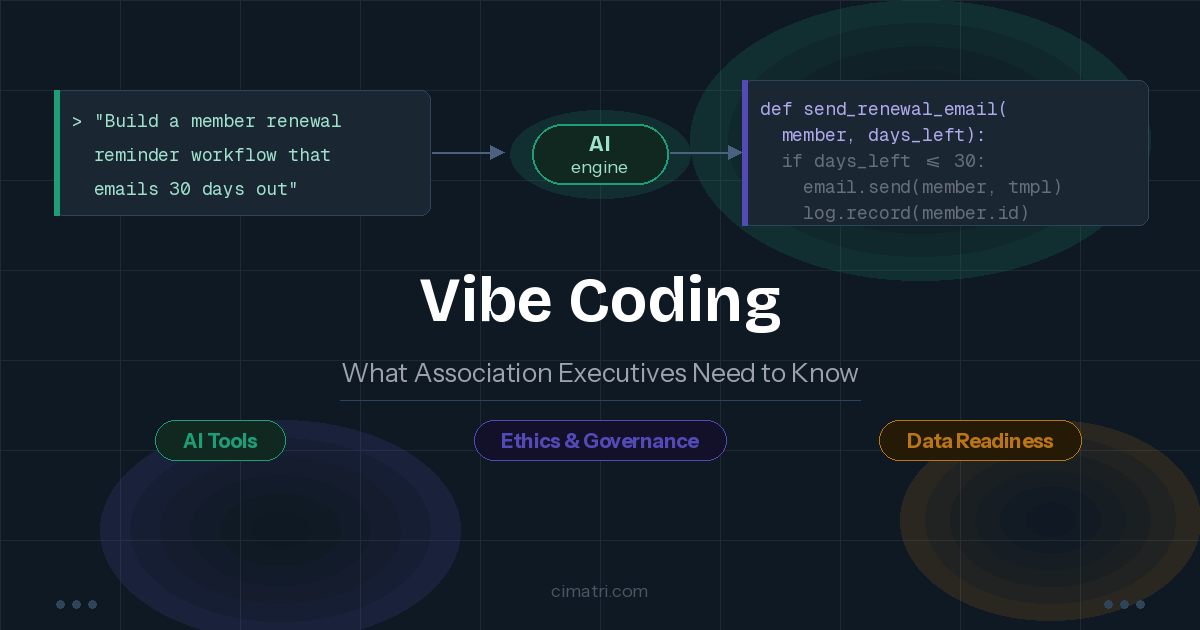
The term was coined in early 2025 by AI researcher Andrej Karpathy, who described a mode of software development in which a person describes what they want in plain language, and an AI coding assistant generates the actual code. The human's role shifts from writing syntax to directing intent — essentially "vibing" with the AI rather than commanding a compiler.
In practice, vibe coding looks something like this: you open an AI tool, type "build me a member event registration form that connects to our database and sends a confirmation email," and the system produces working code. You review it, refine your prompts, test the output, and iterate. At no point do you necessarily write a single line of Python, JavaScript, or SQL yourself.
This is categorically different from earlier low-code or no-code tools. Those platforms abstracted complexity through pre-built components and visual drag-and-drop interfaces. Vibe coding uses generative AI to produce original code from natural language — which means it is far more flexible, far more powerful, and far more unpredictable than anything that came before it.
Is It Appropriate for the Association Environment?
The short answer is: yes, in the right contexts, with the right guardrails.
Associations are not software companies. Most operate with lean staff, stretched budgets, and a genuine need to do more with less. Historically, that has meant choosing between expensive custom development, rigid off-the-shelf platforms, or simply going without. Vibe coding introduces a third path: mission-aligned staff who can build lightweight tools, automate workflows, and prototype new member services without waiting months for an IT vendor or spending six figures on a developer.
The use cases are real and growing. Member-facing tools such as custom calculators, resource finders, or event registration workflows are well within reach. Internal automation — pulling data from your AMS, generating reports, connecting systems that don't talk to each other — is an area where vibe coding can deliver immediate ROI. Board portals, chapter communication tools, and lightweight dashboards are all reasonable candidates.
That said, vibe coding is not appropriate for every problem. High-stakes systems — payment processing, personally identifiable information, credentialing records, financial reporting — require professional developers who can reason carefully about security, reliability, and regulatory compliance. Vibe coding is a powerful supplement to professional development capacity, not a replacement for it.
What Skills Are Needed?
Here is where many organizations stumble. Vibe coding lowers the floor of software development dramatically, but it does not eliminate the need for judgment, context, and accountability.
The people best suited to vibe coding in an association context tend to combine several capabilities. They should be analytically comfortable — able to read code outputs at a high level, even without writing code themselves, and recognize when something looks wrong. They need strong problem-definition skills: the quality of AI output is directly proportional to the clarity of the prompt. Vague direction produces vague results. They should also understand data sufficiently to know what they're asking the system to touch, move, or transform.
Perhaps most importantly, effective vibe coders cultivate what might be called productive skepticism. AI models confidently produce incorrect code. They miss edge cases. They make security errors. The vibe coder who accepts every output at face value is setting their organization up for failure. The one who tests rigorously, asks the AI to explain its reasoning, and escalates when something feels off is the one who delivers value.
Formal software engineering experience is genuinely not required. But curiosity, careful thinking, and a willingness to verify are non-negotiable.
What Tools Are Needed?
The AI-assisted development landscape is evolving rapidly. A handful of tools have emerged as the primary environments for vibe coding work.
Cursor is currently the most widely adopted AI-native code editor. It integrates large language model assistance directly into the coding environment and handles the back-and-forth of iterative development particularly well.
GitHub Copilot is deeply integrated into Microsoft's developer ecosystem and is a natural choice for organizations already operating in that environment.
Claude, ChatGPT, and similar general-purpose AI assistants can be used for vibe coding even without a dedicated development environment — useful for prototyping or staff who are just beginning to explore the space.
Beyond the AI layer, your organization will also need some basic infrastructure: a place to host what gets built (cloud providers like AWS, Azure, or Google Cloud offer accessible entry points), a version control system to track changes (GitHub is standard), and some form of testing environment so that nothing goes directly from "the AI wrote this" to production.
The total tooling cost can be quite modest — which brings us to the economics.
What Does It Cost?
This is one of vibe coding's most compelling arguments for resource-constrained associations.
The leading AI coding tools range from free to approximately $20–40 per user per month for professional tiers, with enterprise pricing available for larger organizations. Hosting lightweight internal tools on cloud platforms can cost as little as a few dollars per month, depending on scale. Compared to the cost of even a few hours of custom development, the economics are striking.
But the real cost equation is about staff time, not software licenses. Vibe coding requires investment in learning — expect a meaningful ramp-up period before staff become productive, often measured in weeks to months, not days. There is also an ongoing cost of oversight: someone needs to review what gets built, test it, and maintain it over time.
Organizations that treat vibe coding as "free software development" will be disappointed. Those that think of it as a way to multiply the capability of curious, capable staff — at a fraction of traditional development costs — will find the value proposition compelling.
What Are the Ethics of This Approach?
Association leaders who adopt vibe coding take on ethical responsibilities that deserve explicit attention.
Data stewardship is the most immediate concern. When staff use AI tools to write code that touches member data, that data may be exposed to third-party systems during the development process. Organizations must understand the data policies of the tools they use, and staff must be trained never to include real member information in prompts or testing environments.
Transparency matters too. If your association builds member-facing tools using AI assistance, stakeholders deserve to understand that — not because AI involvement is inherently problematic, but because your members trust you with their information and professional development. Openness about your methods reinforces that trust rather than undermining it.
Accountability cannot be outsourced to the AI. When an AI-generated tool produces incorrect output, loses data, or creates a poor experience for a member, the organization is responsible — not the model. This requires a cultural posture in which staff understand themselves as the authors of what the AI produces, not merely the operators of it.
Finally, equity deserves consideration. AI tools are not uniformly accessible across staff skill levels, comfort with technology, or available time for learning. Associations committed to inclusive workplaces should be intentional about who gets access to these tools, who gets support in learning them, and how the productivity benefits are distributed internally.
What Guidelines Should You Establish?
Before your organization takes its first step into vibe coding, establish a governance framework. It does not need to be elaborate, but it does need to exist.
At minimum, your guidelines should address the following: which categories of data may never be used in AI prompts; which systems may and may not be built using vibe coding approaches without professional review; how AI-generated tools are documented, versioned, and maintained; and who has final authority to approve a vibe-coded tool before it goes into use.
You should also establish a review process for anything that touches member-facing services. The bar for "good enough" is higher when the output carries your organization's name and your members' trust.
Finally, create a clear escalation path. When staff encounter a problem that exceeds their ability to solve through AI assistance — a security concern, an integration complexity, a compliance question — they need to know who to call and that calling is encouraged, not a sign of failure.
The Strategic Moment
Vibe coding is not a fad. It represents a genuine shift in how organizations of all sizes can access software development capability. For associations, which have historically been dependent on vendors for technical capacity, it opens meaningful possibilities: faster experimentation, more responsive member services, and the ability to build tools that actually fit the way your organization works rather than the way a platform was designed to work.
The executives who will lead their organizations well through this shift are not necessarily the ones who understand it most technically. They are the ones who ask the right questions: What problems are we trying to solve? Who on our team has the judgment to do this responsibly? What guardrails will protect our members and our mission?
That kind of leadership — curious, disciplined, and clear-eyed about both the possibilities and the risks — is exactly what the association sector has always been built on. Vibe coding simply gives it a new arena to work in.
This post is intended to orient association executives to an emerging space. Technology capabilities and tool landscapes in AI-assisted development are evolving rapidly; leaders are encouraged to conduct ongoing learning and consult technical advisors as they develop organizational approaches.
Before You Vibe Code Anything, Ask This Question: Is Your Data Ready?
Vibe coding can generate powerful tools quickly — but every one of those tools is only as good as the data it runs on. If your member records are fragmented across disconnected systems, inconsistently formatted, or riddled with duplicates, no amount of clever AI-generated code will produce reliable results. Garbage in, garbage out is not a cliché; it is the governing law of AI-assisted work.
This is the foundational challenge that Cimatri Intelligence was built to solve. Designed specifically for associations, Cimatri Intelligence combines a unified AI Data Platform (AiDP) with intelligent AI agents and expert implementation support — giving your organization the clean, connected, AI-ready data infrastructure that makes tools like vibe coding actually work.
Before your team builds its first AI-assisted application, it is worth asking whether the data underneath it is structured, unified, and trustworthy. If the honest answer is "not yet," that is the right place to start.
Learn how Cimatri Intelligence helps associations build the data foundation Vibe Coding requires →

Related Posts