The market shift is already here. Is your association watching from Waterloo?
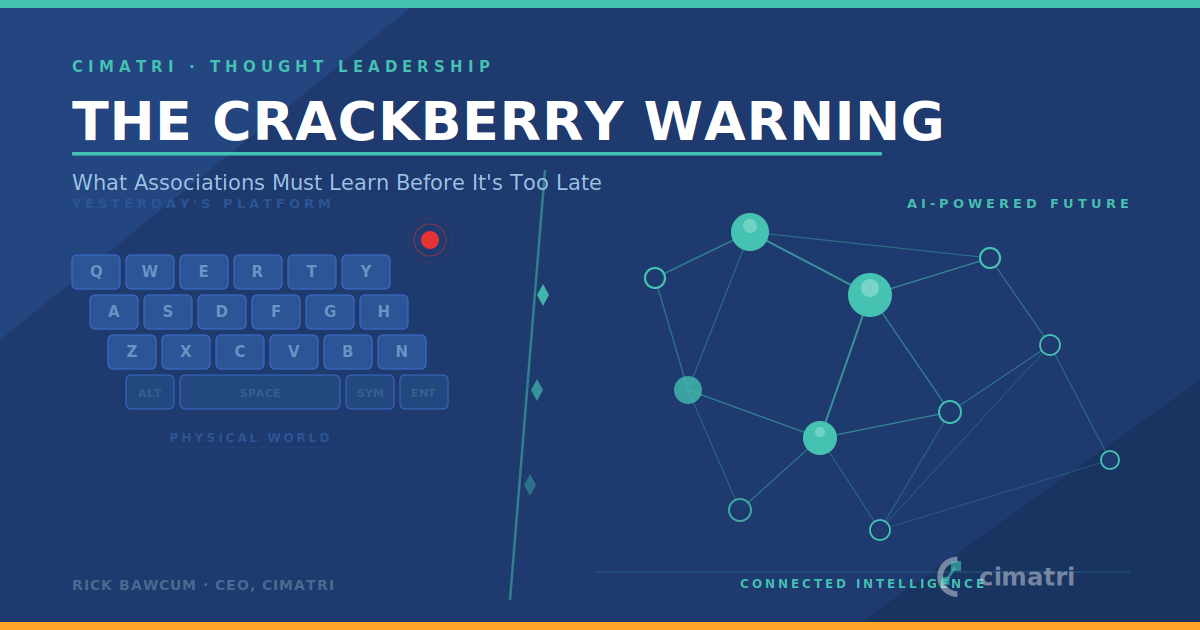

I was there.
Not in Waterloo, Ontario, and not on the stage in San Francisco — but I had a front-row seat to the BlackBerry era in a way that still shapes how I think about disruption today. As a senior IT executive at PageNet, we were one of RIM's early and most significant enterprise customers. We lived and breathed those devices. We built workflows around them. We staked operational credibility on the promise that this little keyboard-equipped rectangle was the future of mobile communication.
And we were right — until we weren't.
I watched BlackBerry fall from $67 billion in market cap to a footnote. And what haunts me still isn't that they missed the iPhone moment. It's how they missed it. With full visibility. With plenty of warning. With every resource in the world to respond. They saw the signal clearly and explained it away because they were too invested in the thing that had made them great.
I see that same posture taking root in associations today. And I think it's worth saying out loud.
The Captured Market Illusion
Associations operate in one of the most enviable positions in the knowledge economy: a largely built-in audience. Members join because the professional community, the credentialing, the networking, and the advocacy don't exist anywhere else. There's an implicit loyalty baked into the model. Renewal rates become a measure of inertia as much as value. And over time, that stability can quietly become complacency.
BlackBerry had the same thing. Enterprise IT departments didn't just prefer BlackBerry — they mandated it. Security policies were written around it. Procurement cycles assumed it. The carrier relationships, the enterprise contracts, the sheer organizational lock-in were extraordinary. Sound familiar?
The danger isn't that your members will leave tomorrow. The danger is that you'll interpret their continued presence as validation of your current value proposition — when what it may actually signal is that the alternative hasn't arrived yet.
It will.
The Moment You Don't See Coming
On January 9, 2007, Steve Jobs walked onto a stage and held up a rectangle of glass. BlackBerry's co-CEO told the press it was just another competitor. Their co-founder looked at the technical specs and said the networks couldn't handle it. They were right about nearly every detail they evaluated.
They were catastrophically wrong about everything that mattered.
What Jobs unveiled wasn't a better phone. It was a platform — an entirely different philosophy about what a mobile device was for. BlackBerry kept asking "how do we protect what we've built?" Apple asked "what can we build that didn't exist before?"
Associations face a version of this moment right now.
The disruptors aren't just coming from adjacent industries or well-funded startups. They're being built by small teams using AI that can deliver personalized professional development, dynamic credentialing pathways, curated peer networks, legislative tracking, and real-time industry intelligence — at a fraction of the cost and with none of the membership overhead. They don't need 40 years of institutional history. They need a good AI stack and a sharp value proposition.
And here's the part that should keep every association CEO up at night: your members may not even realize they're switching. They'll just quietly start getting their answers, their connections, and their learning somewhere else. Renewal season will be the first time you find out.
The Three Years You Don't Have
This is the part of the BlackBerry story I find most instructive — and most sobering.
BlackBerry didn't collapse overnight. In 2010, three years after the iPhone launch, they still held over 40% of the American smartphone market. They had time. They had cash. They had engineering talent and carrier relationships and enterprise loyalty. They had every resource required to respond.
They wasted all of it in internal disagreement, half-measures, and an inability to cannibalize what had made them successful.
The PlayBook tablet — BlackBerry's answer to the iPad — shipped without native email or calendar apps. Let that sink in for a moment. The company that invented mobile email shipped a competitive product that couldn't do email out of the box. Not because they lacked the capability. Because leadership couldn't align around what they were actually trying to build.
I see this dynamic play out in associations regularly. Strategy retreats produce bold language about digital transformation and AI readiness. Then those initiatives get handed off to a committee, deprioritized against the annual conference, or quietly stalled when they bump into legacy systems and institutional inertia. The three years pass. The window closes.
The BlackBerry lesson isn't "move fast or die." It's something more nuanced: you must be willing to make decisions that feel like self-betrayal before the market makes them for you.
What "Moving with Intention" Actually Looks Like
I want to be clear about something: I'm not advocating for panic, and I'm not suggesting associations should chase every AI trend that surfaces on LinkedIn. That's a different kind of mistake.
What I am saying is that the associations that will thrive in the next decade are already distinguishing themselves by the quality of the questions they're asking — not the speed of their answers.
Are you genuinely examining whether AI can deliver member value better, faster, or more personally than your current programs? Or are you benchmarking AI adoption against peer organizations in your sector, which is the equivalent of BlackBerry watching other hardware manufacturers instead of watching Apple?
Are your governance structures built to move on AI decisions with appropriate speed? Or does every AI initiative require the same approval process as a dues increase?
Are you building organizational AI fluency at every level — board, staff, and member-facing — or is "AI strategy" a line item in the technology committee's quarterly report?
The associations that get this right won't be the ones that hired an AI vendor. They'll be the ones that fundamentally rethought their value proposition and rebuilt it around what their members will need tomorrow, not what earned loyalty yesterday.
The Warning in the Blinking Red Light
I still remember the feeling of pulling a BlackBerry out of my pocket in a PageNet board meeting and having a full email conversation with colleagues halfway across the country. It felt like the future. It was the future — for a moment.
That's the thing about disruptive platforms. The thing that replaces them always looks impossible right up until it's inevitable.
BlackBerry's co-founder looked at the iPhone and saw what the networks couldn't support. What he didn't see was what his members — his users — were about to fall in love with.
Don't be the organization that has the resources, the relationships, and the runway to respond — and spends it defending the version of yourself that worked yesterday.
Your members are counting on you to show up as what they'll need tomorrow.
The people who are crazy enough to think they can change the world are the ones who do. - Steve Jobs
Rick Bawcum is CEO and Founder of Cimatri, a digital transformation consultancy serving associations and nonprofits. He is the author of Ethical AI for Associations: Leading with Integrity in the Digital Age (Agentic Edition) and a thought leader on practical AI adoption.

Related Posts