When Member Service is No Longer Limited by Capacity
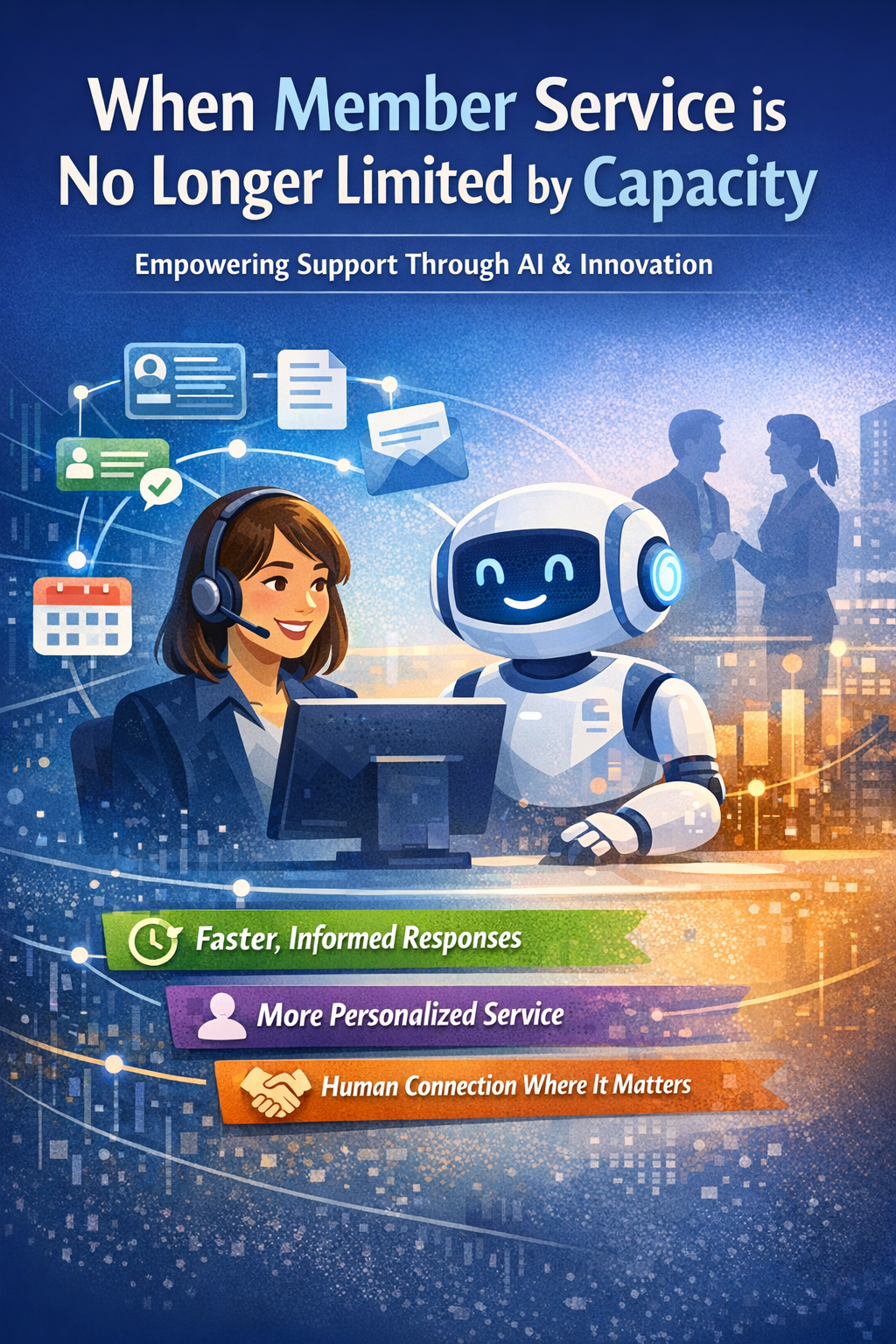

Written by Sara Spalt
January 6, 2025 | Artificial Intelligence, Digital Transformation, Tech Trends,
For most associations, member service has never been a question of intent. Teams care deeply about their members and work hard to support them. The challenge has always been scale.
As organizations grow, member interactions become more complex. Questions arrive with history, context, and expectations for personalization. Delivering thoughtful responses takes time — and time is the one resource member service teams never seem to have enough of.
For years, associations have learned to live with this constraint. Not because it was ideal, but because it felt immovable.
That constraint is starting to loosen.
The Work Members Don’t See
A strong member service response is rarely just an answer. It’s the result of preparation.
Before replying, staff often need to piece together information from multiple places: membership status, past interactions, registrations, policies, and internal knowledge. That invisible work is what makes a response feel informed and relevant rather than generic.
It’s also what makes great service difficult to sustain at scale.
When volume increases, teams are forced to make tradeoffs. Context gets lighter. Responses get shorter. The focus shifts toward throughput rather than depth. Over time, this becomes normalized — not because it’s preferred, but because it’s necessary.
What Changes When Context Comes First
When context can be assembled automatically, the nature of member service changes in subtle but important ways.
Staff no longer have to choose between speed and quality. Members don’t have to restate information the organization already has. Responses become more consistent, not because they’re scripted, but because they’re informed.
Importantly, this doesn’t eliminate the need for people. It changes how their time is used. Routine preparation work fades into the background, making room for judgment, nuance, and relationship-building — the parts of service that only humans do well.
A Shift We’re Seeing Across Associations
In my work with associations, I’m seeing a broader shift in how leaders think about member service. It’s moving away from being treated purely as a volume-management function and toward being recognized as a meaningful part of the member experience.
When capacity is no longer the primary constraint, the conversation changes. Instead of asking how to keep up, organizations start asking how service interactions can reinforce value, trust, and engagement.
That shift doesn’t happen overnight, and it doesn’t happen without intentional design. But it is becoming achievable in ways it wasn’t before.
From Concept to Practice
Over the past 18 months, the Blue Cypress family of companies has been working through this challenge in a very practical way. Through that work, we developed Izzy — an AI-powered member services agent designed specifically for associations.
Izzy is already being used to support real member interactions, helping assemble context and handle everyday inquiries with consistency and care, while keeping staff firmly in control of the experience. For us, it has served as a concrete example of how member service can evolve when preparation and capacity are no longer tightly coupled.
The Bigger Takeaway
The most important lesson here isn’t about any single tool.
It’s about recognizing that long-standing limits on service quality were structural, not cultural. Associations didn’t lack commitment — they lacked scalable support. As that limitation eases, leaders have an opportunity to rethink what member service can be and how it fits into the broader member journey.
For organizations beginning to explore this shift, seeing a real-world implementation can help clarify what’s possible and what thoughtful adoption actually looks like.

Related Posts