CEOS Ask about Transformation and Autonomy
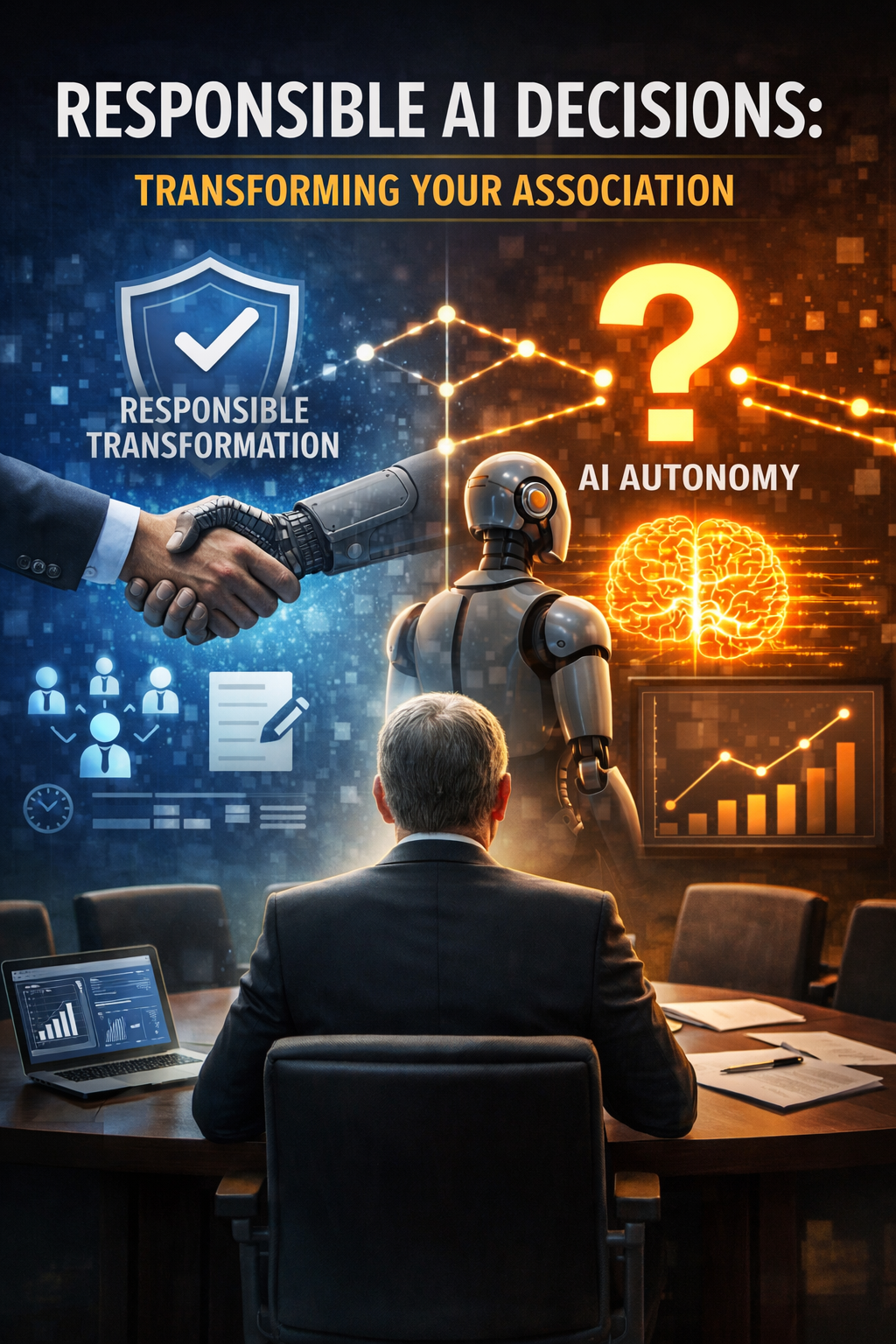

As associations increasingly explore AI solutions—from member engagement tools to operational automation—leaders face two critical questions: How do we transform our organizations responsibly? and When should we allow AI to make decisions autonomously?
After working with dozens of associations on AI maturity assessments and digital transformation initiatives, I've found that success requires two complementary frameworks: one for the transformation journey itself, and one for navigating the specific challenge of AI decision rights.
The SCALE Framework: Your Roadmap for AI Transformation
When I wrote "Ethical AI for Associations: Leading with Integrity in the Digital Age," I developed the SCALE framework to guide associations through responsible AI adoption. It addresses the full transformation lifecycle:
S - Stakeholder Alignment
Begin by engaging your board, staff, and members early. AI transformation isn't just a technology decision—it's an organizational change that affects everyone. I've seen too many AI initiatives fail not because of technical limitations, but because key stakeholders weren't brought along the journey. Ask: Who needs to be at the table? What concerns do they have? How will this change affect different constituencies?
C - Capability Assessment
Honest self-evaluation is critical. Where are you today in terms of data maturity, technical infrastructure, and staff readiness? What gaps exist? Most associations overestimate their readiness and underestimate the foundational work required. A thorough capability assessment prevents costly false starts and helps you sequence your initiatives appropriately.
A - Agile Implementation
Resist the temptation to boil the ocean. Start with pilot projects that deliver quick wins while building organizational confidence. Use iterative cycles: test, learn, adjust, scale. This approach not only reduces risk but creates champions within your organization who can evangelize based on real results rather than theoretical benefits.
L - Learning Culture
AI isn't a "set it and forget it" technology. It requires continuous learning at both the organizational and individual level. Invest in training, create space for experimentation, and normalize productive failure. The associations that thrive with AI are those that embed learning into their DNA rather than treating it as a one-time event.
E - Ethics & Governance
This is non-negotiable. Establish clear policies around data privacy, algorithmic fairness, transparency, and accountability before you deploy AI in member-facing applications. Your reputation for trustworthiness—built over decades—can be damaged quickly if ethics are an afterthought. Build guardrails that reflect your association's values and mission.
The AUTONOMY Framework: Deciding When AI Should Decide
SCALE gets you started on the transformation journey, but it doesn't answer a question I'm increasingly asked: "When should we let AI make decisions on its own versus requiring human oversight?"
This isn't a binary choice between full automation and complete human control. It's a spectrum, and where you land depends on context. That's why I developed the AUTONOMY framework to help association leaders think systematically about AI decision rights:
A - Audit the Decision Impact
Start by asking: What's actually at stake? A decision about which content to feature on your homepage has very different implications than a decision about member disciplinary action. Consider financial impact, reputational risk, legal liability, and member relationship consequences.
U - Understand Reversibility
Some decisions are easily undone; others aren't. An AI-generated email subject line can be changed for the next send. An automated membership rejection sent to a prospective member? That's harder to walk back. Reversibility should directly influence how much autonomy you grant.
T - Transparency Requirements
Can you explain how the AI reached its decision? More importantly, should your stakeholders know AI was involved? For some decisions, members expect and deserve transparency about automation. For others, it's operationally invisible and unimportant to them. But you should always be able to explain the "why" behind any AI decision.
O - Oversight Mechanisms
What's the right level of human involvement? Three common models:
- Human-in-the-loop: AI recommends, human approves before action
- Human-on-the-loop: AI acts, but human monitors and can intervene
- Automated with periodic review: AI operates independently with regular audits
Each has its place depending on risk and volume.
N - Normative Alignment
Does this decision align with your association's mission and values? Have you tested for bias? An AI tool might be technically accurate but still produce outcomes that conflict with your commitment to equity, inclusion, or professional standards. Your values should veto technical efficiency when they conflict.
O - Organizational Readiness
Do you have the technical capability to monitor AI decisions? Is your staff trained to recognize when AI is going off the rails? Too many associations implement AI without building the organizational muscle to manage it. Readiness isn't just about having the technology—it's about having the people and processes to govern it.
M - Member Trust Threshold
This is perhaps the most important consideration: Would your members expect human judgment here? Some decisions carry an implicit social contract that a person—not an algorithm—is accountable. Violating that expectation, even if the AI performs well technically, can damage trust in ways that are difficult to repair.
Y - Yield Analysis
Finally, what's the benefit-to-risk ratio? High-volume, low-stakes decisions (like optimizing email send times) offer significant efficiency gains with minimal risk. High-stakes, low-volume decisions (like credentialing exceptions) offer limited efficiency gains but carry substantial risk. Let the math guide you.
Putting It Together: A Tiered Approach
Using both frameworks together, I recommend associations adopt a tiered approach to AI autonomy:
Tier 1: Full Autonomy (Low risk, high volume, easily reversible)
- Content recommendations based on member interests
- Email send time optimization
- Meeting scheduling coordination
- Basic data categorization and tagging
Tier 2: Supervised Autonomy (Medium risk, human review before execution)
- Drafted responses to common member inquiries
- Initial membership application screening
- Content moderation recommendations
- Event session recommendations
Tier 3: Advisory Only (High risk/impact, human retains decision authority)
- Member disciplinary actions
- Major policy recommendations
- Strategic planning insights
- High-value contract negotiations
- Certification exam appeals
Moving Forward: Start with Assessment
If you're serious about responsible AI adoption, begin with two assessments:
- Use SCALE to evaluate your overall readiness for AI transformation. Where are your gaps? What foundational work is needed?
- Use AUTONOMY to map your current and proposed AI use cases across the autonomy spectrum. Are you giving AI too much decision-making authority too quickly? Or are you bottlenecking efficiency by requiring human approval for truly low-risk decisions?
The associations that will lead in the AI era aren't necessarily those that adopt AI fastest—they're the ones that adopt it most thoughtfully, with clear frameworks for both transformation and governance.
What frameworks are you using to guide your AI journey? I'd love to hear what's working in your association
Rick Bawcum, CAE, CISSP, AAiP, is CEO and Founder of Cimatri and author of "Ethical AI for Associations: Leading with Integrity in the Digital Age." He specializes in helping professional associations and nonprofits navigate digital transformation with integrity.

Related Posts